
Maintaining safe roadways is a core responsibility for departments of transportation (DOT) worldwide. One of the most critical aspects of road safety is pavement friction, which affects vehicle control and braking, especially on wet surfaces. Friction levels matter most around corners and intersections, where braking is frequent — yet traditional friction testing methods often fall short in those exact locations. Historically, DOTs have relied on crash data to identify friction issues, but this reactive approach leaves room for improvement. Compounding the problem, standard locked wheel skid testers (LWSTs) are limited in their ability to measure friction on curves and intersections, precisely where it's most needed. To ensure safe, consistent traction on high-traffic roads, DOTs need a more precise, proactive solution. Enter continuous friction measuring equipment (CFME), a significant leap forward in friction measurement technology, with tools like the GripTester offering unmatched precision and reliability for real-time data.
Locked wheel skid testers (LWST) have long been the go-to technology for DOTs measuring road surface friction, particularly on straight highway segments. Here's an overview of how LWSTs function, their benefits, and their limitations.
How LWST Works
- During an LWST test, water is sprayed in front of a locked wheel, which is forced to skid along the pavement. The equipment measures the frictional force generated between the tire and the surface, providing a "skid number" (or friction coefficient) that indicates the surface's grip.
- Ribbed tires (ASTM E501) are used to measure microtexture, while smooth tires (ASTM E524) are used for macrotexture. This distinction allows DOTs to detect both small and large surface irregularities.
- LWST systems are defined under ASTM E274 standards, which set the test methods for measuring pavement skid resistance with a full-scale tire.
Advantages of LWST
- Simple and user-friendly design
- Testing can be performed at highway speeds, reducing lane closures and traffic disruptions
- Provides straightforward friction measurement data
Disadvantages of LWST
- Limited to straight road segments, unable to capture friction data on curves and intersections
- Skid number represents an average friction reading over a 60-foot section, limiting precision in high-risk areas
- Requires a water tank between 200 and 500 gallons, which can be impractical in remote areas
Although LWST technology has been a mainstay, its limitations underscore the need for a more advanced approach — particularly for intersections, curves, and other high-risk segments that demand greater data precision. This is where continuous friction measuring equipment (CFME) outperforms traditional methods.
Ready To Enhance Your Friction Testing Program?
Fill out the form and get a quote for a GripTester today. Our expert sales team will help you determine the right unit for your needs.
What Is Continuous Friction Measuring Equipment?
Continuous friction measuring equipment (CFME) like the GripTester represents a modern, data-driven approach to friction testing. Unlike LWSTs, CFME systems continuously record friction levels as the testing vehicle moves, providing detailed friction data at much smaller intervals. CFME technology is built to measure and analyze surface conditions in real time, making it ideal for high-precision testing across a wide range of road environments.
Key Features of Continuous Friction Measuring Equipment (CFME)
- High-Resolution Data Capture: CFME records friction data at small, repeatable intervals — the GripTester MK2 captures a friction coefficient every 8 inches, providing a complete picture of road surface friction. This is invaluable for corners and intersections.
- Adaptable for Curves and Intersections: Unlike LWST, which only works on straight sections, CFME measures reliably through curves and intersections, making it ideal for high-risk areas.
- Real-Time GPS and Data Logging: CFME units include advanced GPS and data logging capabilities, enabling operators to pinpoint exact problem areas and upload data directly for analysis.
- Controlled Slip Ratio: CFME operates with a slick measuring tire at a controlled slip ratio. The GripTester MK2 uses a 15% fixed braked slip with an ASTM 1844 measuring tire, producing accurate friction coefficients across a wide range of surfaces.
- All-Weather Testing Capability: CFME handles a wide range of weather conditions, though very high levels of standing water should still be avoided for the most accurate readings.
Benefits of Continuous Friction Measuring Equipment (CFME)
With CFME, DOTs can transition from a reactive to a proactive approach to road safety:
- Proactive Safety Maintenance: Continuous monitoring of friction levels allows DOTs to address low-friction areas before accidents occur.
- Increased Data Precision: Capturing friction data at sub-foot intervals delivers a highly detailed view of road conditions, ideal for high-risk sections where precise data is critical.
- Cost-Effective Maintenance: Precise data allows DOTs to identify and prioritize specific areas for maintenance, reducing unnecessary interventions and lowering long-term costs.
- Proven Technology: CFME has been used for decades on European highways and U.S. airport runways, establishing a solid track record of reliability and accuracy in friction management.
CFME vs. LWST: A Side-by-Side Comparison
For DOTs evaluating the best tools for friction testing, here's a direct comparison of CFME (specifically the GripTester MK2) and LWST:

Federal Highway Administration’s Accelerated Innovation Deployment Grant
DOTs looking to integrate CFME into their friction testing programs can take advantage of the Federal Highway Administration's Accelerated Innovation Deployment (AID) grant. This grant supports innovative safety technologies and can cover a significant portion of the equipment cost for eligible state agencies. Applying for AID funding is a practical way for DOTs to adopt advanced friction measurement solutions like the GripTester MK2 and enhance safety across their road networks at a fraction of the typical capital cost.
The Choice Is Clear: CFME
Maintaining safe road conditions requires consistent, accurate friction measurement — especially on high-risk areas like curves and intersections. While the traditional locked wheel skid tester has provided a foundation for friction testing, it lacks the precision and flexibility needed for modern roadway safety management. Continuous friction measuring equipment (CFME) offers a superior alternative, providing high-resolution data, proactive safety monitoring, and proven reliability across both highway and airport applications. With funding options available through the FHWA's AID grant, DOTs can upgrade their safety practices and strengthen road safety across the network.
Ready to add a GripTester to your friction testing program? Contact our team to find the right configuration for your road network and start building a more proactive approach to surface safety.
Blog
Featured Articles

GripTester MK2 Buyers Guide
Safe runway operations are the most critical responsibility of any airport operations team, especially under wet conditions when aircraft braking and directional control are most at risk. The GripTester MK2 is one of the most trusted continuous friction measuring equipment (CFME) units on the market and is currently in service at more than 550 airports worldwide.
Top 5 Friction Measuring Devices In 2026
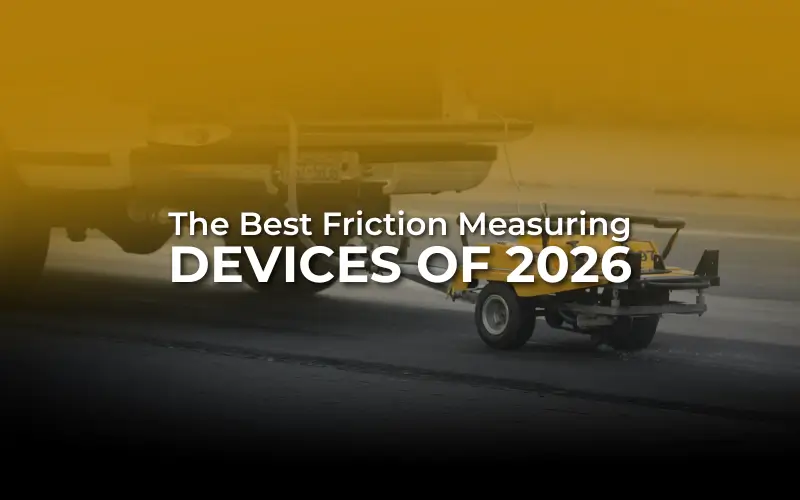
Selecting the right friction measuring device is critical for maintaining safety and performance standards on runways, roads, and racetracks. Understanding the strengths and weaknesses of each option ensures sound decision-making for pavement management. Here, we review the top 5 friction measuring devices available in 2026, evaluating each on its capabilities, limitations, and ideal applications.

What Is Continuous Friction Measuring Equipment?
Standard locked wheel skid testers (LWSTs) are limited in their ability to measure friction on curves and intersections, precisely where it’s most needed. To ensure safe, consistent traction on high-traffic roads, DOTs need a more precise, proactive solution. Enter continuous friction measuring equipment (CFME), a significant leap forward in friction measurement technology, with tools like the GripTester offering unmatched precision and reliability for real-time data.