
Selecting the right friction measuring device is critical for maintaining safety and performance standards on runways, roads, and racetracks. Understanding the strengths and weaknesses of each option ensures sound decision-making for pavement management. Here, we review the top 5 friction measuring devices available in 2026, evaluating each on its capabilities, limitations, and ideal applications.
Visual surface inspection involves assessing pavement conditions visually, typically conducted by trained personnel or automated imaging systems. While rudimentary, it remains useful for initial assessments.
Best Use Cases: Preliminary evaluations, identifying visible surface deterioration.
Strengths:
- Cost-effective
- Immediate visual feedback
- No specialized equipment required
Weaknesses:
- Highly subjective and inconsistent
- Limited precision
- Cannot quantitatively measure friction
#4 British Pendulum Tester (BPT)
The British Pendulum Tester is a portable, in-place friction measuring device used primarily for pedestrian and low-speed vehicular surfaces. It uses a swinging pendulum with a standardized rubber slider to measure surface friction.
Best Use Cases: Pedestrian walkways, parking lots, spot-checks.
Strengths:
- Highly portable
- Quick and easy measurements
- Cost-effective
Weaknesses:
- Only measures small pavement sections
- Inadequate for high-speed roads and runways
- Limited accuracy under variable weather conditions
#3 Locked Wheel Skid Tester
The Locked Wheel Skid Tester measures pavement friction by fully locking a test tire while traveling at a designated speed. It remains widely accepted for highway assessments under ASTM E274.
Best Use Cases: Roadways and highways, especially for regulatory compliance.
Strengths:
- Industry-standard for roadways
- Accurate in controlled conditions
- Widely accepted for regulatory testing
Weaknesses:
- Interrupts traffic flow during tests
- Provides friction data at intervals (averaged over ~60 feet) rather than continuously
- Limited insight into surface variability over short distances
Ready To Enhance Your Friction Testing Program?
Fill out the form and get a quote for a GripTester today. Our expert sales team will help you determine the right unit for your needs.
#2 Built-in CFME (Continuous Friction Measuring Equipment)
Built-in CFME systems are permanently installed on specialized vehicles, providing continuous friction measurement along their path. They offer higher resolution friction data than locked wheel testers.
Best Use Cases: Airports, high-speed racetracks, highway condition monitoring.
Strengths:
- High-resolution continuous data
- Reduced test setup time
- Real-time friction monitoring
Weaknesses:
- High initial and maintenance costs
- Requires specialized vehicles and dedicated operators
- Less flexible across multiple testing sites
- Friction testing hardware cannot be removed when not in use
#1 GripTester MK2 – Tow-behind CFME Device
The GripTester MK2, a tow-behind, removable Continuous Friction Measuring Equipment (CFME) device, stands out as the leading friction measuring device in 2026. Robust, reliable, and user-friendly, the GripTester MK2 is recognized by the FAA, ICAO, FHWA, UK CAA, EUSA, and USAF, and is currently in service at more than 550 airports worldwide.
Best Use Cases: Airport runways, highways, racetracks, and military airfields.
The GripTester MK2 uses a fixed-slip measurement principle, with a test tire continuously slipping at 15% relative to the free-rolling drive wheels, simulating real-world braking conditions. It offers precise, high-resolution friction data — capturing a measurement approximately every 8 inches of travel — enabling users to identify even small-scale friction variations critical to safety.
Strengths:
- High-resolution continuous friction measurement (every 8 inches)
- Real-time data collection and immediate feedback
- Robust design suitable for arctic, equatorial, and temperate conditions
- Compliant with FAA, ICAO, FHWA, UK CAA, EUSA, and USAF standards
- Optional Automatic Water Delivery System for consistent wet-condition testing
- Integration-ready software for streamlined data reporting
- Modular construction simplifies maintenance and reduces downtime
- Removable from the towing vehicle when not in use, freeing up cargo space
- All-season use (winter operations or summer maintenance)
Weaknesses:
- Higher initial cost investment than simpler devices
- Requires a towing vehicle (though virtually any small vehicle can tow it)
The GripTester MK2 delivers comprehensive friction profiles that strengthen maintenance and safety decision-making. Its durable, modular design allows quick calibration, easy maintenance, and efficient deployment, minimizing operational disruptions and maximizing equipment uptime.
By accurately identifying low-friction areas caused by contaminants, rubber buildup, or polishing, the GripTester MK2 supports safe operational conditions for airports, roads, and racetracks — reducing accident risk and long-term maintenance costs.
When the MK2 Isn't Practical: The Micro GripTester
For applications where a tow-behind unit isn't practical — helidecks, hospital helipads, motorsports paddock spot checks, or remote pavement surveys — the Micro GripTester delivers the same braked-wheel measurement principle in a portable, push-operated format. Weighing just 20 kg and packing into two carry cases, it's a complementary tool to the MK2 for facilities that need friction data in hard-to-reach places.
Choosing the Right Friction Measuring Device
Each device on this list has its place, but only the GripTester MK2 combines the continuous data resolution of a built-in CFME with the deployment flexibility of a removable, tow-behind trailer — at a fraction of the operational cost. For airports, DOTs, motorsports facilities, and military airfields that need accurate, defensible friction data on demand, the MK2 is the clear choice in 2026.
Ready to add a GripTester to your friction testing program? Contact our team to find the right configuration for your operation.
Blog
Featured Articles

GripTester MK2 Buyers Guide
Safe runway operations are the most critical responsibility of any airport operations team, especially under wet conditions when aircraft braking and directional control are most at risk. The GripTester MK2 is one of the most trusted continuous friction measuring equipment (CFME) units on the market and is currently in service at more than 550 airports worldwide.
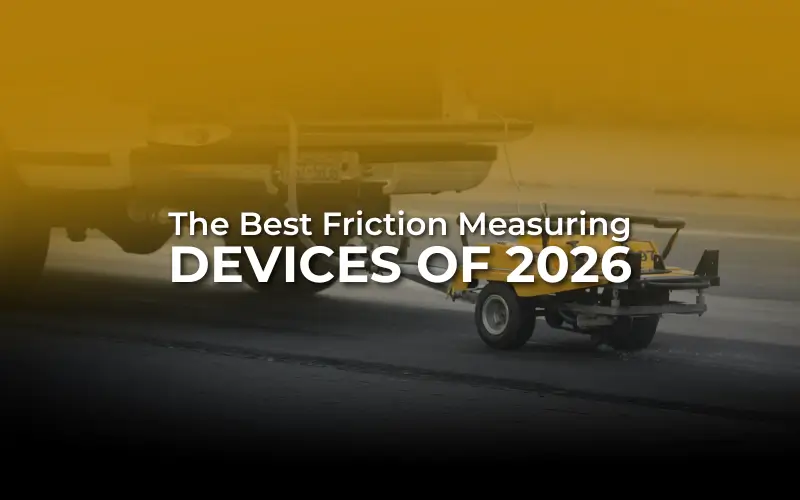
Top 5 Friction Measuring Devices In 2026
Selecting the right friction measuring device is critical for maintaining safety and performance standards on runways, roads, and racetracks. Understanding the strengths and weaknesses of each option ensures sound decision-making for pavement management. Here, we review the top 5 friction measuring devices available in 2026, evaluating each on its capabilities, limitations, and ideal applications.

What Is Continuous Friction Measuring Equipment?
Standard locked wheel skid testers (LWSTs) are limited in their ability to measure friction on curves and intersections, precisely where it’s most needed. To ensure safe, consistent traction on high-traffic roads, DOTs need a more precise, proactive solution. Enter continuous friction measuring equipment (CFME), a significant leap forward in friction measurement technology, with tools like the GripTester offering unmatched precision and reliability for real-time data.